Eight years ago, I hosted a company Hackathon. I had a scheduled Happy Hour to attend afterwards, but I started to feel ill, so I left before the event, congratulating the winners on the way out.
Unfortunately, my illness got worse that night. It was like a stomach flu, but soon turned into a terrible and strange pain that I had never felt before. (And, I’m a pretty tough cookie after having given birth three times, shattered my right leg and been on crutches for year and having suffered a kidney infection that led to blood poisoning & more. Trust me, I’m not easily taken down by a boo boo.)
My husband came down that morning to find me sobbing on the couch, unable to move from a fetal position. Of course, I didn’t want to bother him or the kids while they slept and kept hoping it would somehow magically get better.
He took me to the ER immediately as the terrible, awful pain in my side, back, left shoulder, and arm continued.
As soon as the ER practitioners heard “left shoulder and arm,” they instantly began exploring the possibility of a heart attack, prioritizing an ECG (electrocardiogram) test.
The results of that ECG were normal, much to the practitioners’ surprise. It took many more hours to order & get a CT scan. The CT scan showed that my spleen was lacerated and could potentially rupture, a life-threatening situation. I was admitted to the hospital for monitoring and quickly moved from critical care to intensive care as my condition worsened.
In fact, my spleen did rupture. They called my husband to tell him they were taking me to emergency surgery — and to prepare for the worst. Very honestly, the last thing I remember is watching my stomach inflate with internal bleeding. And I remember a mirror near my bed that let me see my face turn ghostly white. I sent prayers to the universe that I would be able to see my boys again. My husband had taken my sons back home since we have no family in the area, so I was alone when things really started to get scary.
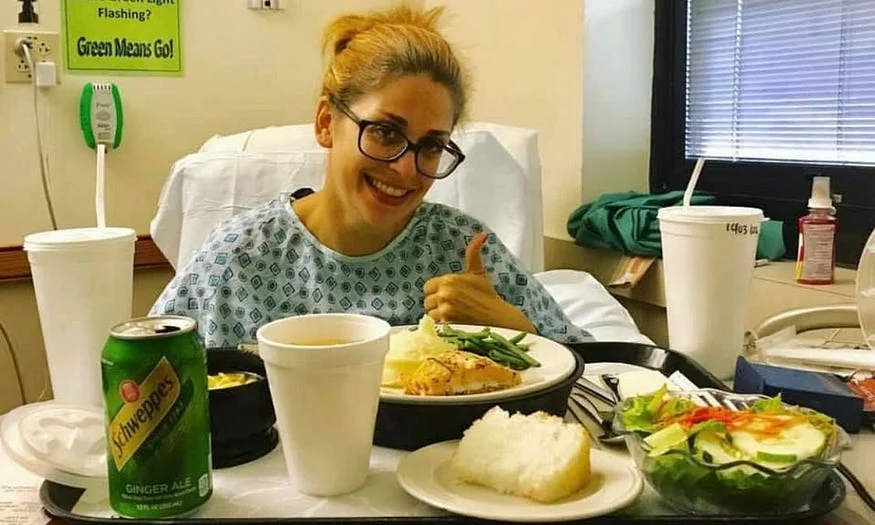
After 6 blood transfusions and a spleen removal, I survived. And don’t worry — I’m happy and healthy today. (In fact, look at that picture! Look at the joy I experienced because I was to eat solids after a week of not being able to! A Sterling Silver Lining is that I came out of this situation quite svelte — also, I joke about scary things so bear with me).
Anyway, why am I writing this here?
Because there’s SUCH a lesson in this. If the medical practitioners hadn’t zoomed in on one specific symptom and solution immediately, and had sanctioned more initial tests to explore the total problem, my issues would have been found sooner, and my surgery would likely not have been life-or-death.
I don’t say this to upset or scare anyone. As I mentioned, I’m doing great, but the analogy really works when you think about what makes so many products today fail before they even get launched.
Product teams do this EVERY. SINGLE. DAY.
“We need AI.” “We need a new dashboard. “We need a redesign.”
Sometimes teams are forced to make decisions based on a single customer comment, an executive’s unmoving opinion, or a fast-moving deadline.
Sadly, those statements are treatments. Not diagnoses.
The Biggest Product Failures Usually Begin with the Wrong Diagnosis
They’re the equivalent of hearing “left shoulder pain” and deciding you already know the answer before you’ve taken the time to understand everything else that’s happening beneath the surface.
The best product teams I’ve worked with over the last twenty years don’t rush to prescribe solutions. They slow themselves down just long enough at the beginning to understand the problem completely, because they know that once an organization becomes emotionally attached to a solution, it becomes exponentially harder to ask whether it’s actually solving the right problem in the first place.
Sometimes the answer really is AI. Sometimes you genuinely do need a new dashboard or a redesign.
But just as often, the real issue has nothing to do with the solution everyone is debating.
Maybe your onboarding experience is creating unnecessary friction. Maybe your checkout workflow requires fifteen clicks where three would do. Maybe your pricing model is confusing customers. Maybe your users don’t trust the recommendations or data you’re giving them. Maybe the team never aligned on what vision and success looks like before anyone started building.
The technology wasn’t the problem. The diagnosis was. And all of the symptoms were there.
So before your team falls too far in love with the first solution someone suggests, here are a few habits that have saved me (and the teams I’ve worked with) from building the wrong thing.
-
Ask “Why?” at least five times. The first problem someone brings you is rarely the actual problem. Keep peeling back the layers until you find the root cause instead of the symptom that’s easiest to see.
-
Collect evidence from more than one source. One customer interview, one executive opinion, one support ticket, or one salesperson’s frustration can all be incredibly valuable. None of them should become your entire product strategy. Look for patterns across qualitative research, quantitative data, customer behavior, support trends, and business goals before deciding where to invest.
-
Separate the problem from the proposed solution. When someone says, “We need AI,” ask what outcome they’re actually trying to achieve. When someone asks for a dashboard, ask what decision they can’t currently make or what the user needs to do with that data. When someone requests a new feature, ask what job they’re trying to accomplish. Those conversations almost always become more interesting … and far more productive.
-
Test the smallest possible assumption first. You don’t need six months of engineering effort to learn whether an idea has merit. Build the smallest experiment you can, put it in front of real users, and let their behavior (not your confidence) tell you what to do next.
-
Stay willing to be wrong. The strongest product leaders I know aren’t the ones who always have the right answer. They’re the ones who become less attached to being right than they are to discovering the truth. Curiosity will almost always outperform certainty.
Fortunately for me, the medical team found the real issue before it was too late. But, as we all know, not every product gets that second chance.
The next time someone confidently declares, “We need AI,” “We need a new feature,” or “We need to redesign everything,” I hope someone in the room is willing to ask one more question (or maybe “5 more why’s”) before prescribing the treatment.
Because the most expensive product decisions usually aren’t the ones that fail.
They’re the ones that successfully solve the wrong problem.
That’s why I’m dedicating my professional life to helping companies solve the right problems — before building the right solutions.